August 21, 2026
Stop Repainting the House
Most companies don’t have an execution problem. They have an assumption problem.
Here is something I have watched happen more times than I can count.
Growth stalls. Leads flatten. CAC creeps up. Conversion quietly erodes. And the company responds the only way it knows how, by doing more of what it was already doing.
More campaigns. More features. More budget. A new agency. A brand refresh.
It is the business equivalent of the old joke: “The food here is terrible… and such small portions.”
They are miserable with the results, so they double down on the same approach.
When growth stalls, there are only three possible explanations
- You have an execution problem. The strategy is right. The team is just not running it well enough.
- You have an operations or resource problem. You need better tools, more budget, or stronger talent.
- You have a strategy problem. The foundation itself is broken.
Most companies exhaust options one and two, because at one point option 3 was working (and it’s usually the hardest to change).
They swap creative. They add headcount. They change agencies. They restructure teams. Sometimes it works… for a while. But if things keep reverting to the same plateau no matter what you try, you are not looking at an execution problem.
You are looking at a foundational problem. And no amount of execution fixes that.
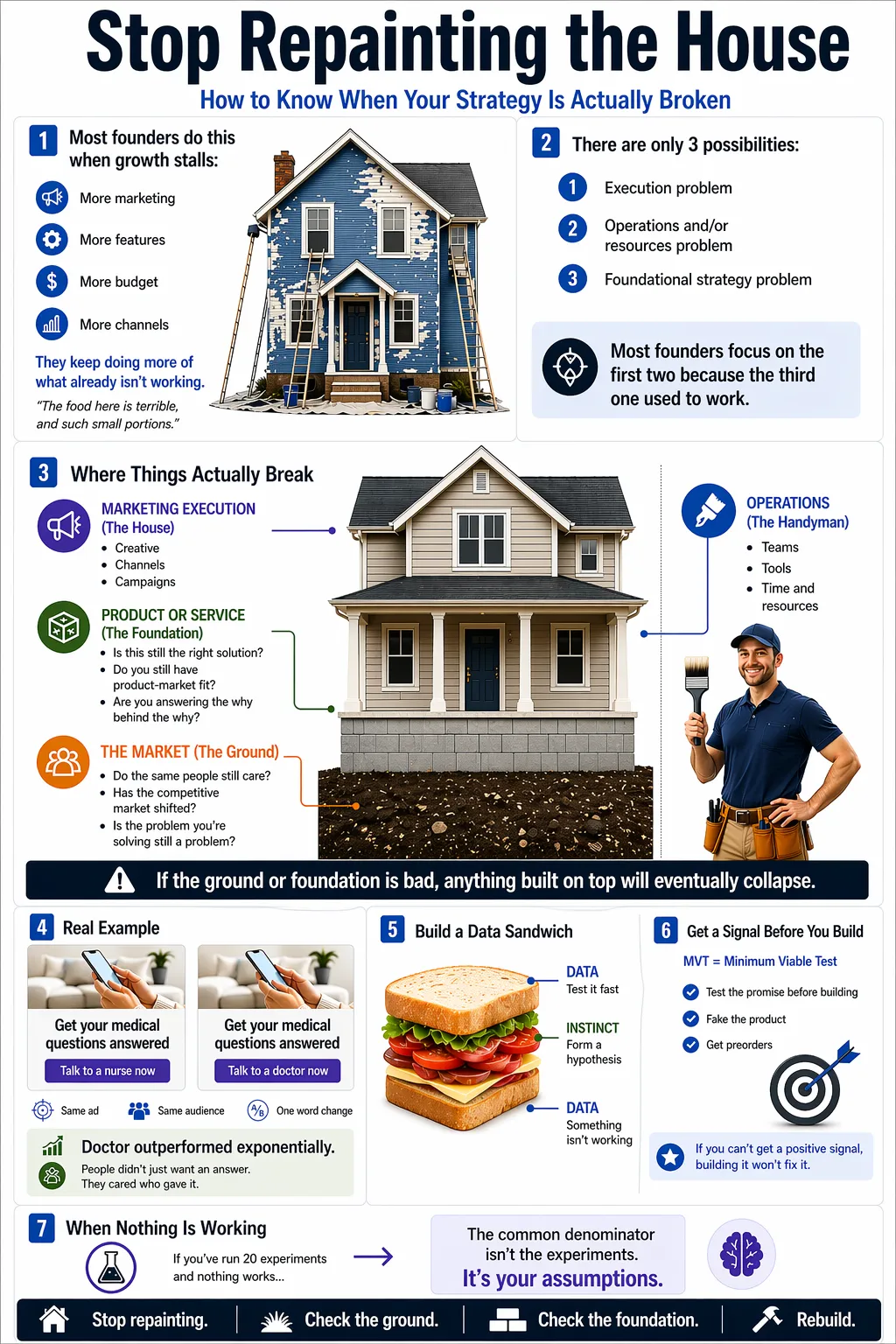
Think of your business as a house
The ground is the market: the problem you are solving and the people experiencing it.
The foundation is your product: your actual solution and whether it fits how people want that problem solved.
The house is your marketing: your brand, your messaging, creative and execution.
The handyman is your operations: the teams, tools, and systems that keep everything running.
When growth slows, almost every company focuses on the house and the handyman, it’s the quickest and easiest to change. They repaint the exterior. They rearrange the furniture. They hire a new handyman and give him better tools.
Almost no one stops to ask the harder question:
Is the foundation cracked? Has the ground itself shifted?
Because if either of those is true, nothing at the house level will fix it. You can change the trim forever and the house will still collapse.
A quick way to understand this
Imagine a company that sells dog bones. Sales are flat no matter what they try — new flavors, better packaging, lower prices, influencer campaigns. They run test after test. Nothing moves.
At some point they should have stopped and asked a different question entirely:
What if the problem isn’t the bones?
As it turns out, all their customers were cats.
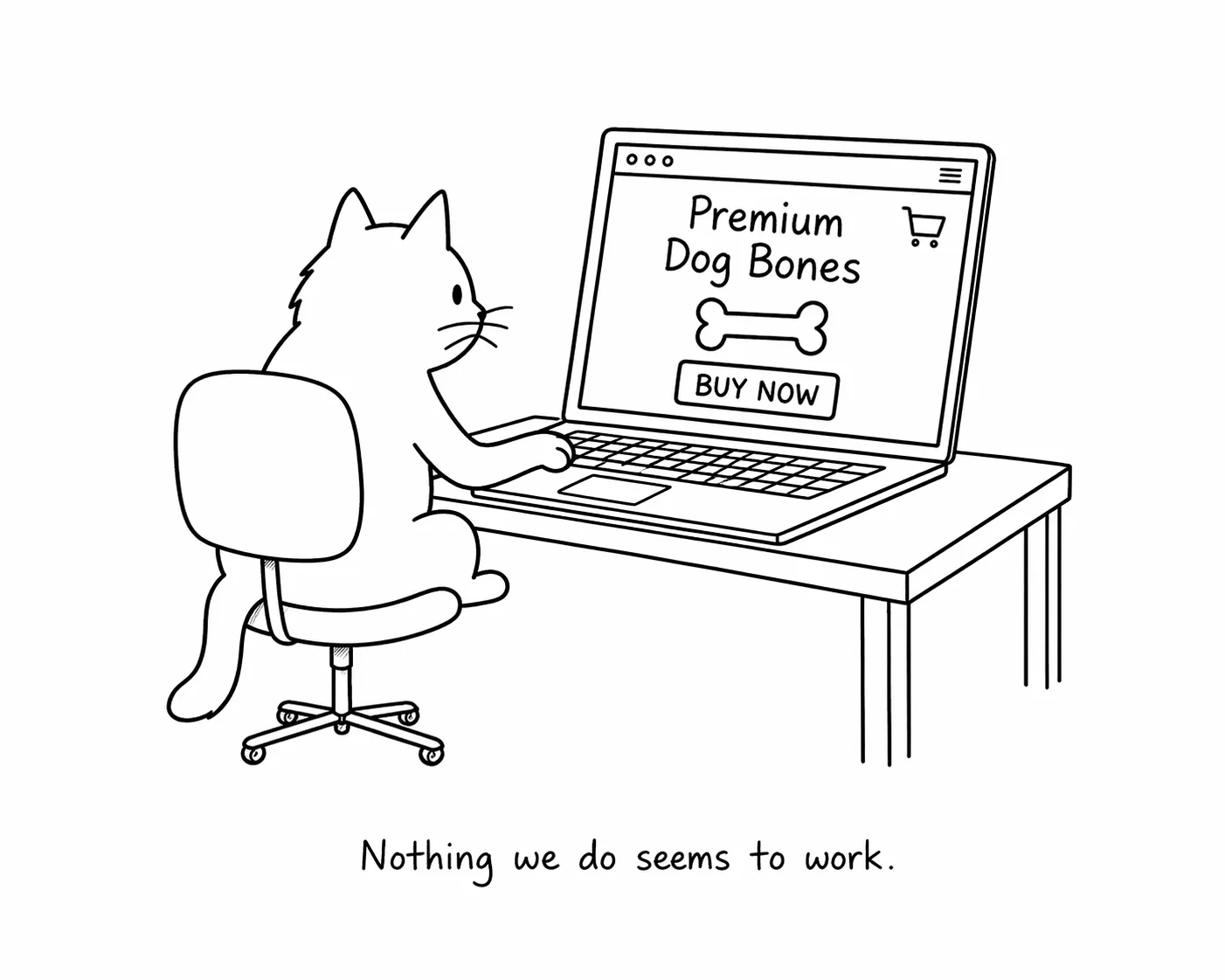
It doesn’t matter how good the marketing is. It doesn’t matter how efficiently they operate. If the market isn’t who you think it is, you’re solving a problem that doesn’t exist for the people you’re selling to. The ground is wrong.
Now flip the scenario. Imagine an apartment building where residents complain the front door takes too long to get through. Management installs a premium smart entry system — facial recognition, mobile access, lightning-fast unlocking. They keep refining it yet the data shows almost no one is using it.
Because the residents stuck a brick in the door.
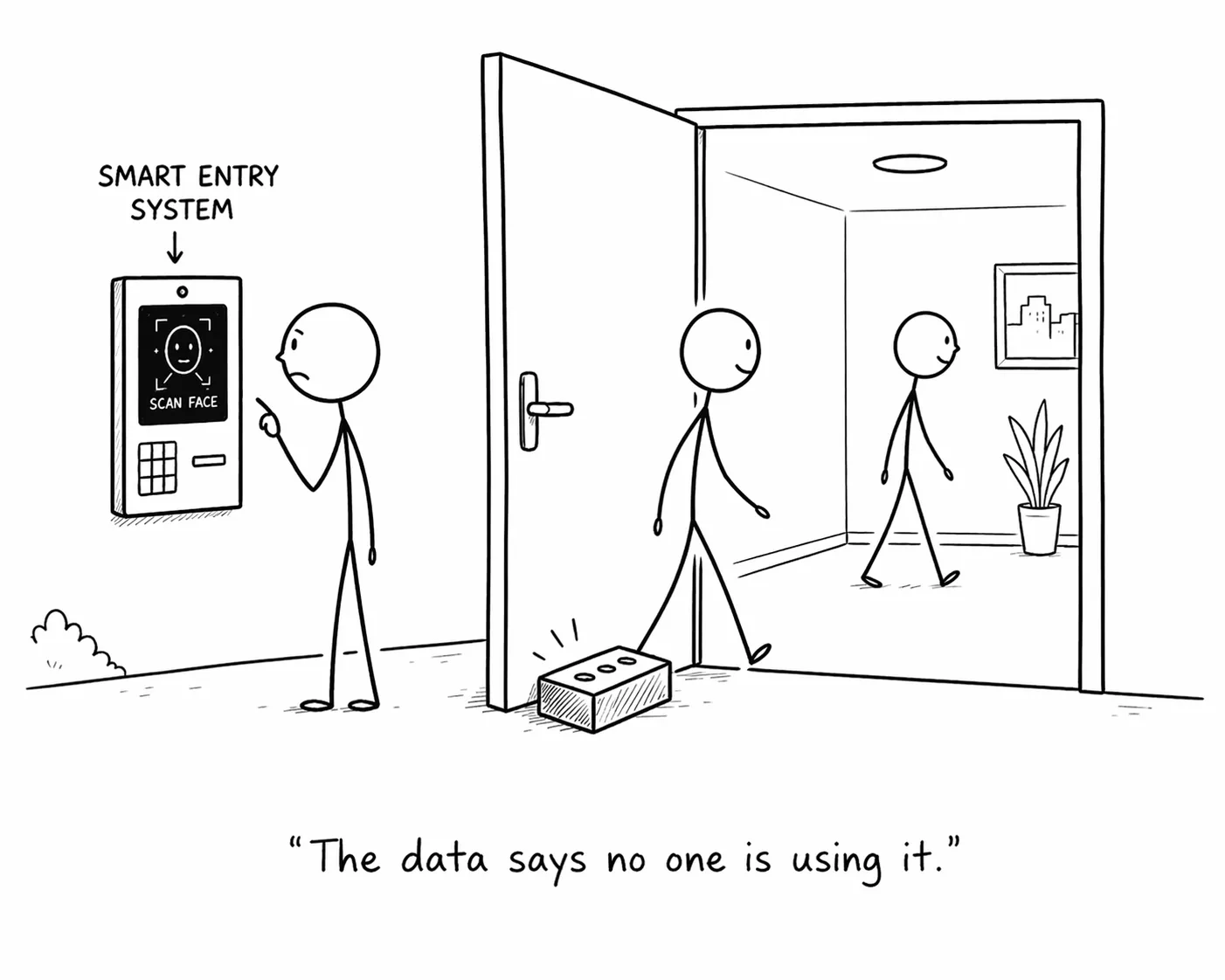
The problem was real. People genuinely wanted to get in faster. But the solution didn’t match how they actually wanted to solve it. They wanted less friction, not more technology. The ground was correct. The foundation was wrong.
Two real cases that illustrate the difference
Case one: when the ground is wrong
We were trying to grow a dial-a-nurse service. On paper it made complete sense, affordable, accessible, genuinely useful. But adoption was flat. No one talked about it. No one seemed to care.
Our turning point was when we asked ourselves:
What if we misunderstood what people actually believe they need?
Our assumption was that people just wanted their health questions answered. What our instinct led us to hypothesize was something more fundamental: people didn’t trust that a nurse could solve their problem. In their minds, only a doctor could do it. The answer wasn’t the issue. The perceived authority behind the answer was.
We didn’t build anything new to test this. We ran one messaging experiment. We ran two identical ads to the same audience, same creative, one word changed. One offered access to a nurse. One offered access to a doctor.
The doctor version outperformed by an enormous margin.
One word. Exponential difference. Because that one word was the ground the whole thing was built on.
Case two: when the foundation is wrong
At another company, we had a cloud-based phone system for small businesses. The problem we were solving was real — small business owners miss calls constantly because they are busy actually running their business.
Where we went wrong was the solution. We assumed they wanted what big businesses had: a full phone system with a receptionist, menus, routing, extensions, automation, just more affordable. So we built it. And it didn’t take off.
We tried more features. Better pricing. A rebrand. Nothing moved.
So I walked my downtown main street and talked to every small business owner I could find. I asked them two questions:
Do you have a problem answering your business line? Every single one said yes.
How do you actually handle it today? Cheap answering machines.
They weren’t waiting for a sophisticated phone system. They wanted something simple that just answered the call and took a message reliably.
I went back a week later and asked: “If we offered a simple, affordable solution that only answered your business line and sent you the message, would you buy it?”
They all said yes. Several preordered on the spot.
The problem was exactly right. The solution was completely wrong. The ground was solid. The foundation had a crack running straight through it.
How to actually diagnose which layer is broken
Before you change anything, you need to know what you’re actually changing. The worst thing you can do is pivot on instinct alone.
Think of the process as a data-instinct-data sandwich:
Data first. Something isn’t working. The numbers are telling you something. Start there.
Instinct next. Based on what you’re seeing, your professional experience, and what you know about your customers, your market, your category, form a specific hypothesis. Not a vague feeling. A falsifiable statement: “I believe the problem is X, and if I’m right, then Y should happen when I test Z.”
Data again. Validate the hypothesis with an MVT that gives you real-world signals before you commit. Not internal debate. Not waiting for irrefutable proof. Positive, data-backed signals to move on.
Before you build an MVP, build an MVT
This is the mistake I see most often when companies do decide to pivot.
They commit to the new direction and try to validate it with a minimum viable product. That is still too slow and too expensive. You need positive signal before you build anything.
A minimum viable test can be a single ad that promotes a product that doesn’t exist yet. It can be a landing page with a waitlist. It can be walking back into the same interviews and asking the people you talked to last month: “Would you actually buy this?” and then taking a preorder.
In the nurse-versus-doctor case, the test was one word in a banner ad. In the phone system case, it was a direct question followed by a handshake. Neither required building anything.
If you can’t get a positive signal of demand before you build, building will not create that signal. It will just be a more expensive way to confirm the same problem.
What happens after you validate
Once you have directional signal, the decision becomes clearer, but it isn’t automatic. You still have to weigh cost, timing, resources, and strategic context. Sometimes the right decision is still to stay the course and optimize. But at least now you’re making that choice with clarity rather than desperation.
And if you do decide to move forward, understand that a foundational change is not a campaign refresh. Everything downstream may need to shift, from your brand to your messaging, from your funnel to your channels and budget allocation.
You are not repainting the same house. You are building a new one.
Built on the right foundation. On the right ground.
The real takeaway
Most companies don’t fail because they didn’t work hard enough or move fast enough.
They fail because they kept running experiments on the wrong assumptions and never stopped to question the foundational assumptions themselves.
If you have run twenty experiments and nothing is working, the problem is not your experiments. The common denominator is what you believed to be true before you ran any of them.
So stop repainting.
Check the ground. Check the foundation.
Then decide whether you need to optimize or rebuild.